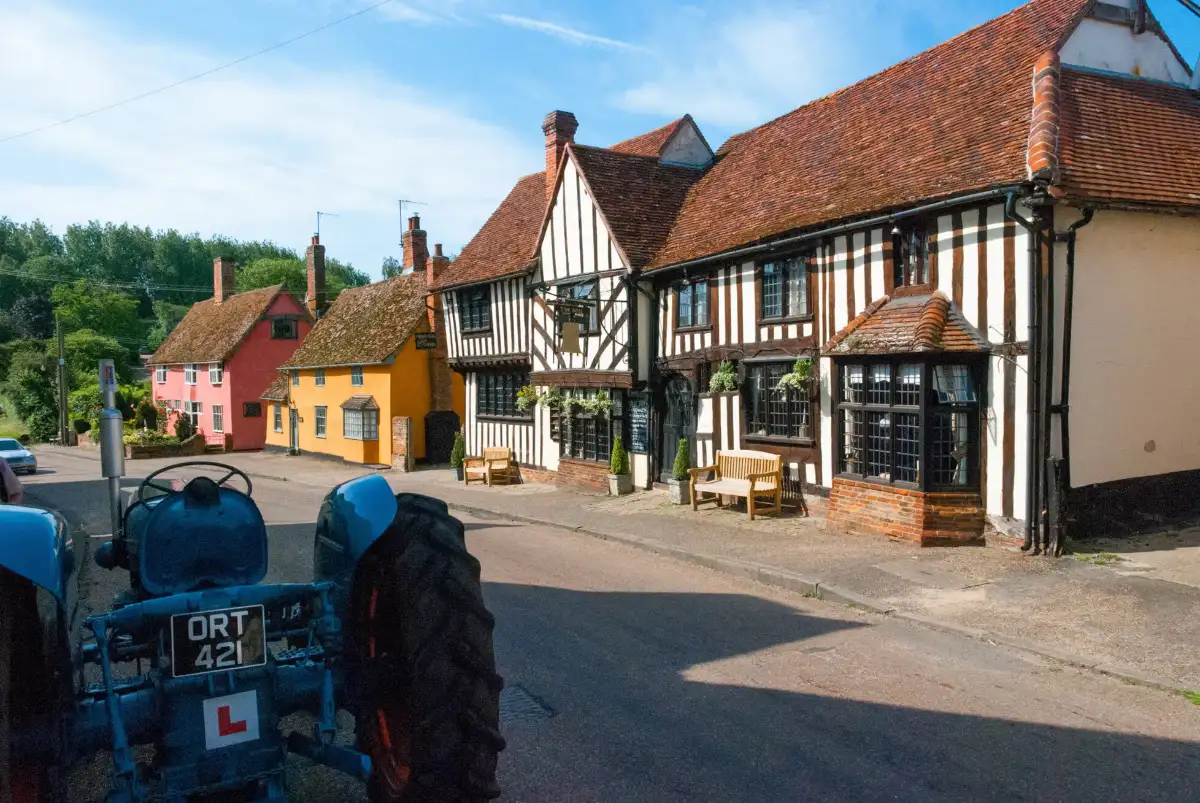


Suffolk large holiday homes don’t often come with a history lesson attached. The Old River House does. Built in 1490 as the principal house of what was already an ancient village, it sits at the heart of Kersey — a place so untouched by the centuries that it is regularly closed to traffic for period drama filming. The house itself is the centrepiece of the shot every time. To stay here is to occupy a piece of England that most people only encounter through a camera lens, and there is something quietly extraordinary about that.
The building is vast, and in the best possible way. A massive internal atrium spans what was once effectively a small medieval street — jutting first floors, mullioned windows, and all — now roofed over into one breathtaking room that feels more like a courtyard than an interior. Brick floors, wide elm boards, ancient beams and wood-panelled walls run throughout. There are two inglenook fireplaces with wood-burning stoves, and a grand kitchen fireplace with its own oven and hotplate alongside the conventional range — the kind of kitchen that actually rewards cooking in it. A complimentary welcome pack of essentials is provided on arrival, along with firelighters and firewood for the stoves.
The bedrooms are super king throughout (splitting to full-size twins when needed), and the sense of sleeping inside genuine medieval history — crooked walls, low beams, candlelight-worthy character — is something no amount of interior design can manufacture. The owners have spent years in careful, unhurried restoration; during that work, medieval wall paintings were uncovered and preserved rather than plastered over. That restraint and respect for the building runs through everything here.
Kersey’s famous ford — known locally as The Splash — is visible from the house. The village is extraordinarily quiet, the lanes are single-track, and the footpaths lead through meadow and vale to nowhere in particular, which is precisely the point. The enclosed walled garden has its own views down Kersey Vale, and there is a bike available for guests who want to explore further afield.
For an evening meal, The Bell is a short walk up the lane — a proper Suffolk village pub with food that comfortably exceeds pub expectations, and the kind of atmosphere that makes it easy to stay for one more. For something more considered, The Great House in Lavenham is around fifteen minutes by car: a French-Mediterranean bistro in a 14th-century Grade II listed building on Lavenham’s market square, with a weekly-changing menu, a well-chosen wine list, and the sort of unhurried room that suits a long dinner between two people. Booking ahead is advisable for both.
Lavenham itself — England’s best-preserved medieval village, a few miles north — is worth a day in its own right, crooked timber-framed houses and all. Long Melford, with its antique shops, galleries and The Black Lion overlooking the green, is equally close. Constable Country — the Stour Valley landscapes that inspired England’s most celebrated landscape painter — begins effectively at the doorstep. The Suffolk coast, with Aldeburgh, Orford and Southwold among its quieter rewards, is fifty to eighty minutes away: far enough to feel like a day out, close enough not to feel like an expedition.
The property sleeps eight across two super king doubles, a twin room, and the ground-floor Bakery suite — a former bread oven room with its own en suite bath and shower, and a wall still lined with ancient bake ovens. One well-behaved dog is welcome. For couples, the Bakery suite has its own entrance from the garden and a character that no purpose-built annexe could rival. For those arriving by train, London Liverpool Street to Colchester takes under an hour, with a taxi from there to Kersey around thirty minutes.


